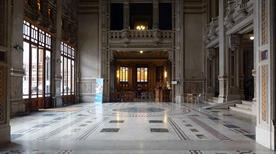
Terme Berzieri
Salsomaggiore Terme
(28 Km)
The Berzieri Thermal Baths are a true monument in Art Nouveau deco opened in 1923.Inside you can enjoy the benefits of beauty and relaxing treatments thanks to the properties of the Salsobromoiodica Water, in a unique frame in the world.

Palazzo dei Congressi
Salsomaggiore Terme
(28 Km)
It is part of one of the monuments of the Ways of Liberty. Inside there are sumptuous rooms used for congresses or prestigious tournaments. To visit the Cariatidi Room, the Red Tavern etc..
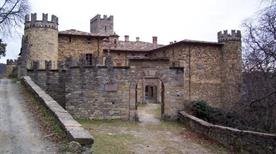
Castello di Castelcorniglio
Solignano
(12 Km)
The Castle of Castelcorniglio was erected during the 13th century around the Pessola stream. It was the home of Manfredo Pallavicino to then move on to Niccolò Piccinino and ultimately to Gustavo Buratti Zanchi. The fortress was the starting point for various sabotage actions against the Parma-La Spezia railway after the Second World War.

Castello di Compiano
Compiano
(19 Km)
The fortification was built in 1141 by the Malaspina family. The castle has an irregular quadrilateral structure, consisting of three towers. Inside the building is decorated with luxurious furnishings. Currently, two important museums are set up in the rooms of the castle: the “Raimondi Gambarotta” Collection and the Museum “Masonic Horizons”. The structure is owned by the Municipality.
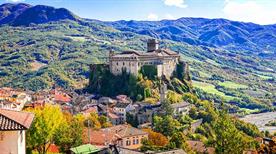
Castello di Bardi
Bardi
(14 Km)
The Castle of Bardi was built around the 13th century at the behest of Ubertino Landi, Count Piacenza. The fortress was born with the function of defence and protection of the Ceno and Taro valleys. The structure is impressive, and in the past it was able to accommodate up to four hundred people, as well as welcoming soldiers with spaces dedicated to them. Around 1400 the outer towers were added and kitchens and torture rooms were used in the basement parts of the building.
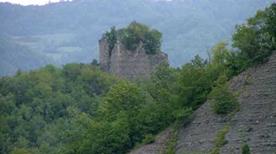
Castello di Gravago
Bardi
(12 Km)
The Castle of Gravago was built around the 13th century and is part of the multitude of defensive castles wanted by Ubertino Landi. It is located in one of the wildest buttresses in the area and has a square plan with remains of some city walls, as well as an ancient tower.
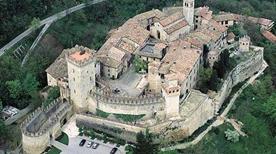
Castello di Vigoleno
Vernasca
(28 Km)
The Castle of Vigoleno was built in the tenth century as a medieval fortified village. In 1922 it was restored by Princess Ruspoli Gramont, who transformed it into a residence for social meetings with great movie stars. Inside there are museum rooms where historical and photographic documents are exhibited. The Castle enters the list of the most beautiful villages in Italy.
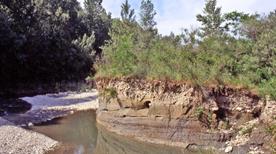
Parco Regionale Fluviale dello Stirone
Salsomaggiore Terme
(29 Km)
It is a protected area of paleontological interest.The erosive action of the stream that, following the massive gravel excavations of the 1950s, brought to light layers of fossils. Floristic, vegetational and wildlife aspects.
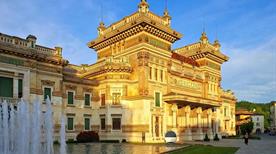
Fontana di Piazza Berzieri
Salsomaggiore Terme
(28 Km)
In front of the Berzieri Thermal Baths is this beautiful fountain that cheers tourists and not only with its water games and colors. Don't miss the evening show, even more impressive
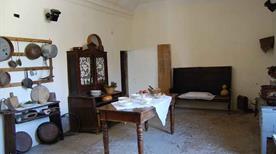
Museo della Civiltà Valligiana
Bardi
(14 Km)
The Museum of Civilization Valligiana is located in the south wing of the Castle of Bardi. The Val di Ceno Study Center decided to establish this Museum with the aim of collecting materials to testify to the local civilization. The rooms welcome objects of domestic and mountain crafts, linked to the economy of the woods and shepherding.
Pinacoteca "Parmigiani"
Bedonia
(21 Km)
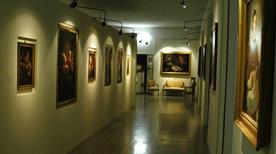
The art gallery is located in the interior of the Episcopal Seminary of Bedonia, and consists of a large collection of paintings, part of the private collection of Vittorio Parmigiani, from which it also took its name. The collection of Venetian and Tuscan ecclesiastical works is divided into two major sections: the Parmigiani collection and the Bolognini collection. The museum is open for all interested parties.
Case Torre di Ponticello
Filattiera
(25 Km)
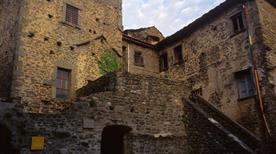
The construction of the Casa Torre di Ponticello dates back to the X-XII century and was a typical fortified house with three floors overlapping with the entrance to the first floor. Through some hatches we passed to the other parts of the building where water and food reserves were kept. The structure is still in excellent condition and is open to the public.
Case Torre di Caprio
Filattiera
(24 Km)
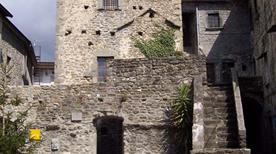
Torre di Caprio houses are typical buildings that are located in the town of Filattiera. These are typical fortified buildings, mainly used in the part of the agricultural sites at the bottom of the valley. They are currently visible in most of the resort and are in excellent condition.
Castello di Montecastello
Filattiera
(24 Km)
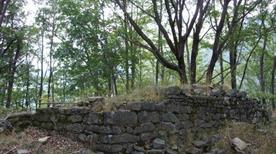
The Castle is presumed to date back around the middle of the 6th century. The tower, like the city walls and parts of the structure were built later. This is also because its function changed over the years. Unfortunately, only the ruins came to us.
Castello di Groppoli
Mulazzo
(30 Km)
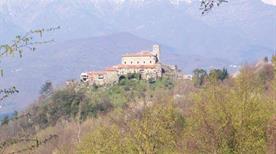
The Castle of Groppoli dates back to the beginning of the Middle Ages. Over the years it has passed into the hands of several owners, who have partially modified the structure. According to some historical findings, only one siege affected the structure particularly. Today it is in excellent condition and open to all those who want to visit it.
Castello di Castevoli
Mulazzo
(31 Km)
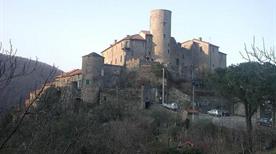
The Castevoli Castle, located in Mulazzo, was built in the 16th century when Tommaso I Malaspina reunified the tower and the keep. The building stands on a hill. Over the years, because of the French raids, it has fallen, losing its splendor. Today it is in good condition, but it cannot be visited since it is privately owned.
Castello di Lusuolo
Mulazzo
(34 Km)
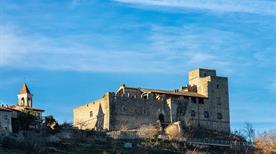
The Castle of Lusoil was built around the twelfth century, according to the written sources that document its presence. Thanks to its raised position, it allowed control of the valley bottom. Today we can see most of its structure, even if small parts have been damaged.
Castello di Montereggio
Mulazzo
(30 Km)
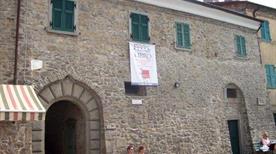
The Castle of Montereggio dates back to 1573, the date when the Marquis moved to the resort. Unlike other castles, this one looks like a palace. The building is located in the historic center, near the church of Sant'Apollinare. It is open to the public and is in excellent condition.
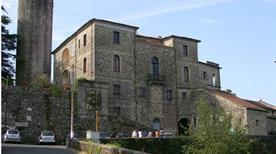
Castello di Bagnone
Bagnone
(30 Km)
The castle of Bagnone is located in the Province of Massa and Carrara. The most important part of the castle is the cylinder shaped tower. This part of the castle has survived to the present day. Instead, there is a medieval structural part of the original village that is in perfect condition. Inside the castle we also find the Church of St. Nicholas. The current owner of the property is a private individual. The castle is not accessible to visitors.
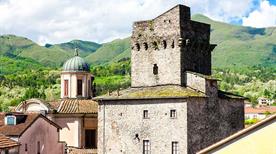
Fortezza di Castelnuovo
Pontremoli
(22 Km)
The ancient fortress of Castelnuovo is located on the left bank of the Magra. The ancient fortress remains a tower and a door with a pointed arch. The fortress was part of the defensive system of the village, which was made up of numerous fortified works.
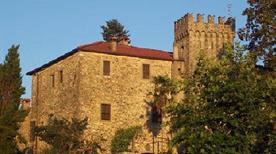
Castello Malaspina di Filattiera
Filattiera
(27 Km)
The castle of Filattiera is a fortress built entirely of stone, of Byzantine origin and extends on both sides of the main square of the city. The fortified structure is a building dating back to the 13th century and has been subject to various renovations. Strong of the feudal Malaspina, it has, inside, three large salons. Today there is very little left and it is a private property. Access and visits to the property are only allowed by appointment.
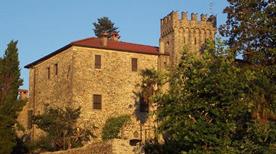
Torre di San Giorgio
Filattiera
(27 Km)
The Tower of San Giorgio was built in the tenth century. The structure was later restored in the 14th century. The tower has a quadrangular shape and is 4 meters high. The upper part was the only inhabited part.