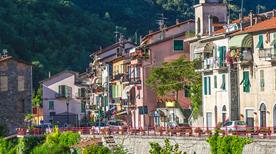
Arranged as an amphitheater between Cape Verde and Cape Nero, Sanremo is a tourist resort of international importance. It is the perfect place to spend a beach holiday among sandy beaches or rocks, walks along the sea thanks to the always favorable climate. However, it is possible to combine with the sea the typical experiences of a holiday in the mountains: the hinterland offers possibilities for excursions, itineraries to be traveled on foot or in the mountain. bike, forests and typical perched villages. The parks and gardens of exotic plants are ideal places for rejuvenating walks, with the spa treatments of the great hotels of the Riviera, its museums and churches. Everything without taking anything away from a bit of worldliness: the Festival of Italian Song, the concerts of classical music, light, jazz, blues, pop, the events throughout the year, the big sporting events, the port, shopping in the boutiques of the center, the Casino. Even the typical cuisine offers specialties and delicacies of ancient tradition that best enhance the products of the land and the sea: game, fish, the Taggiasca olives and oil, fruit, wines, vegetables from the garden, cereals, aromatic herbs, base of famous sauces such as pesto, and finally cheeses from the hinterland including the typical bruss.
Sanremo is known as the pearl of the Riviera dei Fiori, a name that comes from lush gardens, flowerbeds with a thousand colors and tropical plants that grow lush in parks citizens thanks to the mild climate and the favorable geographical position. Yesterday a fishing village, today it is a chic resort on the west coast of Liguria known all over the world by virtue of the Singing Festival of Italian Song that takes place here every year. A stylish walk embellished with palm trees and numerous boutiques, small parks and gardens with tropical vegetation welcome tourists, a luxury casino that gives it a touch of worldliness, and, finally, a joyful and festive atmosphere that reigns throughout the year. But all this is not enough, there are fashion shows and sailing or motor racing, and sports of all kinds from boxing meetings, competitions and tennis tournaments, to automotive Intercontinental Rally Challenge just to name a few. In short, a recipe for every palate! You'll find everything you want at this cosy and mundane seaside resort. Also worth mentioning behind the city the fascinating edge of Bussana old, a medieval village destroyed by an earthquake and abandoned for about sixty years; today it is home to a community of artists from all over the world who through their shops and workshops give a unique charm to the place and a very special atmosphere. Finally, we invite you to discover the 19th century Sanremo, visiting the beautiful Villa Nobel, where the famous Swedish scientist lived, and the botanical gardens of Villa Ormond from the beautiful french garden. It will certainly be an unforgettable experience!
The stage of the Festival of Sanremo, this beautiful seaside town is also known as the City of Flowers, it is really not to be missed. Overlooking the Tyrrhenian Sea, it is part of the province of Imperia in Liguria. A tourist resort renowned for the cultivation of flowers and for the famous festival of Italian song that takes place in February. Sanremo was inhabited since the Paleolithic period, but it was in Romanesque times that it developed more, being founded along the Via Giulia Augusta. In the 9th century, the population was forced to take refuge in the mountains due to the Saracen attacks. Later, the original village was refounded on the coast, near the current area of San Siro and Pigna. During the Middle Ages, thanks also to its geographical position, it made maritime navigation a point of commercial strength, since at the time the roads were Pretty dangerous. In 1837, due to poor sanitation, the city suffered from a severe cholera epidemic, which led to the construction of a new suburban cemetery and a washroom. public. From the end of the 19th century, many famous personalities began to choose Sanremo as a tourist destination, for example: Tsarina Maria Aleksandrovna and Elizabeth of Austria, immortalized by Romy Schneider in the movie Sissi, which tells his life. There are many charming places to visit in Sanremo: The Insigne Collegiate Basilica Cathedral of San Siro (built on the remains of an early Christian church); the Sanctuary of the Madonna della Costa; the Russian Orthodox Church; the Villa Ormond; the Devachan Castle; the Casino and the Ariston Theatre, the stage of the famous festival. Don't waste time! Sanremo is waiting for you.
A famous tourist resort in the province of Imperia, today my story is dedicated to Sanremo. Because I like nature and Sanremo is rich in natural beauty. A fixed appointment every year with one of the most anticipated events among the city events: Sanremoinfiore. The story tells that this event originated in January 1904 with the feast of the “Goddess Flora” during which there was a parade of carriages adorned with flowers, real floral creations along the streets of the city. After the war, this event took the name of Italy in Flowers, becoming, until 1966, one of the most important annual events for the city. After a period of interruption, the event resumed in 1980 and today the Corso Fiorito is followed by about 60,000 spectators who go specifically to Sanremo and is admired by millions of viewers who follow the show on live television. Not to be missed is the medieval historic center, called “La Pigna”, with its carrugi and stairways that lead to the top dominated Sanctuary of the Madonna della Costa, from which you can enjoy an amazing view of the city. An enchantment is to discover the 19th century Sanremo, visiting the beautiful Villa Nobel, where the famous Swedish scientist lived, and the botanical gardens of Villa Ormond.
I especially liked the Russian Church, because this is something special, and the numerous private villas with huge parks are also worth a visit. Sanremo is more than a seaside resort in Liguria. This city is one of the largest on the coast, it has almost sixty thousand inhabitants and has become famous not only for its beautiful beaches. San Remo has a medieval old town, but many buildings were also built in Art Nouveau style. Most of these come from the times when Queen Sissi often stayed in the city. Here you will find the famous Casino, one of the largest in northern Italy, a golf course, and at the time of its construction, the cable car longest in the world, which takes us from the city on Monte Bignone. When you get upstairs and you are lucky with time, from up there you can also see as far as Saint - Tropez, Albenga and in a few days even the island of Corsica. The Ariston Theatre is very famous in Italy, where every year in February the Festival of Italian Song takes place, in which the participation of numerous stars Italian and international is almost mandatory. When you discover the city, you will find a variety of architecture, from Baroque to Art Nouveau, from Romanesque to Neoclassical.
Italy is a beautiful country... rich in culture, history, beautiful places and wonderful cities. Those who choose Italy as a place to spend their holidays, surely know what they want and what they can expect of a trip here. Today we will talk about one thing that women like above all: Shopping! It can never be missing and it is a fundamental part of a journey. The Italian cities are, beyond everything, very fashionable and elegant... a mix of classicism and modernism... in short, the ideal places to make excellent purchases! Today we will talk about the capital of the most famous Festival in the world, Sanremo, a city with a history that is lost over time. Italian women have always been elegant, time passed, but they kept their elegance and good taste. I recommend some of the trendiest shops in Sanremo, located in different streets of the city, known for hosting important internationally renowned boutiques... I recommend a stop at some of these stores: Calvin Klein, Andrews and Co; Fontanelli, La Bottega Due and Mango. If you are looking for something to give away or buy in sports and mixed fashion stores, I recommend: Sisley, Strass Srl, G&G, MaxMara, Di Grazia Antonella. It's really worth spending some time on your trip shopping! Good shopping and travel to everyone!
Sanremo is a tourist resort renowned for growing flowers, celebrated every year with the Sanremo flower course in flower, hence the name of City of Flowers. It also hosts the arrival of the Milan-San Remo cycling race, one of the most important classics of cycling, the Festival of Song Italian, the motorsport rally, and is home to the Casino. The geographical position, in a cove sheltered from the mountains, is the main cause of the city's renowned mild climate, which makes it a destination for stays both summer, both winter, even healing. To visit is the Sanctuary of Madonna della Costa, called by citizens and better known to tourists as Madonna della Costa , has always been a point of reference for sailors as it was built on top of the hill of Pigna, home to the primitive nucleus of the city, and Villa Nobel an elegant building that “due to the speed and elegance of its forms pleases the most scrupulous in wanting to fulfill the rules of art Since 2002 the villa, completely restored in its original forms, it is open to the public and can be visited free of charge, and houses a museum on discoveries and inventions of the nineteenth century. Finally, the Italian Song Festival takes place at the Theatre and remains essentially a singing competition in which several performers propose songs composed by Italian authors, and voted by juries chosen or through popular voting.
Sanremo is a Ligurian city of 56,526 inhabitants belonging to the province of Imperia. The inhabitants stand out between Sanremaschi (born and lived in Sanremo for generations) and the Sanremo (of forest origins but residents in Sanremo). Sanremo is often called the City of Flowers because its particular position close to two mountainous ridges affected by the meekness of the sea favors the cultivation of flowers. Sanremo is also very well known because it is home to the Festival of Italian Song and countless events that attract numerous tourists annually. The origins of Sanremo date back to the Palaeolithic even if the greater development of the territory has occurred from the influence of the Roman Empire. Today there are numerous religious and civil architectures that you can visit in Sanremo, among these certainly worth a visit the Collegiana Basilica Cathedral of San Siro, the Sanctuary of the Madonna della Costa, the Bellevue Palace, Palazzo Borea and Villa Nobel. Tourists are also attracted by the beauty of the beaches and the clear sea that has obtained the Blue Flag several times.
Bordighera is located in Western Liguria, a few kilometers from Sanremo and Montecarlo. Known for its climate, for the beauty and charm of its landscapes, the seaside town was built on a hill dominating the sea as a fishing village. The city was founded by a group of families in the 15th century and then developed and extended towards the coast creating < strong>gardens, villas and tree-lined avenues with a predominant tourist vocation. In fact, in different corners of the village are still evident the footprints of an elegant tourism, especially English, that make it & lt; strong>unique in its architectural style. A characteristic element of Bordighera are the palm trees, symbol of the city, offering suggestive exotic landscapes in a straight two kilometers long that runs between the railway and the beach, flanked by beautiful rows of Araucaria excelsa and colorful gardens with succulents and flowers. The Argentine Waterfront is the longest pedestrian beach promenade on the Riviera; from here you can admire the incomparable panorama, where the gaze embraces the coast to the Fortress of Turbie, to the skyscrapers of Montecarlo, the promontory of Cap Ferrat and beyond. Immediately after the Punta Migliarese tunnel, on a steep rocky slope overlooking the sea, with bands and terraces populated by beautiful plants rises the Pallanca Exotic Garden, spectacular natural monument. There are three thousand two hundred species of plants among which stands out the precious collection of cacti, the most important in Italy and one of the most important in Europe.
Bordighera, a flowery city On the “Riviera dei Fiori”, the charming Bordighera station attracts tourists and artists from the whole world from the nineteenth century who enjoy the equipped bathing establishments and the numerous cultural services offered. Bordighera is located at the foot of the Maritime Alps, on the coast of the Ligurian Riviera di Ponente, twenty kilometers from the border with France. This enviable location, with the mountains descending to the sea, makes this beautiful city a tourist destination that enjoys a mild climate both in winter and summer. The ancient fortified village is still visible in the historic center and built with irregular pentagonal shape, surrounded by powerful walls of the late Middle Ages. Today we can stroll through the dense network of alleys and squares, typical of Ligurian villages. Bordighera can also boast the longest seafront on the Riviera with its 2 straight kilometers along the beach. This walk is called the 'Argentine Waterfront' because it was inaugurated by Evita Perón in 1947. Among the many famous people who went to Bordighera, it is impossible not to mention the famous painter Monet who spent several months in the city and who inspired himself by the beautiful Lowe gardens for some of his paintings. And it is precisely in these gardens that the Bordighera JAZZ and Blues Festival is held every year at the end of August.
Villatalla stands as a hillside about 350m above sea level, on the western slopes of Val Nervia. And in the typical Mediterranean vegetation of the garrigue, with a broad view of the valley and back with his eyes, the hills and peaks of the Ligurian Alps. The landscape that opens in front Villatalla is an amphitheater that is a reminder that Nature always has good taste. Liguria is a region rich in historical traditions. From time immemorial served as the crossroads between Eastern and Western Europe. It is also surprising to find that the Ligurian are one of the oldest breeds known to the world. For the traveler there are infinite possibilities for discovery and exploration. For water enthusiasts there are in the vicinity, the several towns of Bordighera, Ospedaletti, San Remo, with its numerous beaches, Mentone in France and Monte Carlo in Monaco for those who love shopping. For the experts in botany, a necessary stop will be the largest gardens in Europe, those of the Villa Hanbury Mortola right on the border with France, and related to the renowned Museum of Prehistory of the Balzi Rossi, which houses the remains of man-Cro Magnon. The gardens Pallanca however, are in Bordighera and boast an exceptional collection of rare cacti plants. For those interested in architecture the mysterious and medieval villages built like eagles' nests on rock outcrops, spectacular villages of Pigna, Castelvittorio, Apricale, Bajardo, Triora, and many others, will lead the traveler to discover untouched areas from the era where modern but at the same time, gradually you are a work of art and cultural upgrading so necessary for the rebirth of these unique valleys.
The combination of an ancient soul, guardian of stories, and a laughing city. This is the feeling I have in visiting Ventimiglia: walking through medieval and modern buildings I realize how its two aspects are well mixed. Remarkable views of the coast, which every summer enchants us and enjoys us with the beautiful sea and its people. Ventimiglia, the last Italian city before the French territory, just 8 km away from the border, is a small gem: the historic center, from visiting carefully offers us history and culture among fascinating religious buildings such as the Cathedral of the Assumption, erected in the twelfth century on an ancient pagan temple, in which are kept valuable works of art. It was a noble English gentleman who planted the first exotic species of plants from the Botanical Gardens of Villa Hanbury, built in the 19th century. Today, the University of Genoa takes care of the park so that we visitors can enjoy it. Ventimiglia is a city of flowers that decorate the center every year with the different species. Here the weather is mild and pleasant: the coldest month is January.
One of the most interesting places I visited in Italy was, undoubtedly Ventimiglia in Liguria. It is ideal for people who love contact with nature, plus if you like flowers; the city is rightly known for producing different types of beautiful flowers. The sea of Ventimiglia invites us to take a dip, if the weather and season allow us, of course! Its waters are clear and transparent, and they give us a delightful feeling of tranquility... take the opportunity to relax sitting on the sand, feeling the light breeze overlooks and caresses your face, and Enjoy the heady scent of sea air and the soothing sound of ocean waves. I also recommend to couples in love an ultra-romantic walk on the shore of the beach during the late afternoon... ah... and if you're cold it doesn't matter, this will be one more reason for be in the warm arms of the person you love! Who knows the evening does not end on an intoxicating night of love illuminated by a walk and toasted with a good Italian wine?! The reasons to celebrate?! There are many... the journey, love and the pursuit of eternal happiness! Have fun and fall in love in Ventimiglia!
Sir Thomas Hanbury decided in 1867 that he had gained enough money with exporting Chinese tea and wanting to return to Europe. He chose the Ligurian coast to settle and bought a beautiful palace in Ventimiglia. He restored the building in an excellent way and gradually bought the surrounding land until he had eighteen hectares of it. Together with his brother Daniel they transformed the fertile soil that went down from the promontory to the sea, into a beautiful garden. Trees, shrubs and plants came from all over the world and thanks to the microclimates present on the terraces of the land, they created wonderful gardens of species of different backgrounds. In 1960, the Hanbury family was forced, due to financial problems, to sell the complex to the Italian state. Today it is the University of Genoa that takes care of it. Divided on eighteen hectares are mostly tropical and subtropical plants, which form a show of shapes and colors, while turning to the side you have a splendid view of the Ligurian Sea below . The gardens are open to the public all year round, offering the opportunity to enjoy a peaceful and relaxing visit in all seasons.
Ventimiglia in Liguria is the last Italian city on the coast. It is very popular with tourists from all nearby regions such as Piedmont and Lombardy. The city has a long history, the Romans already settled here, so I could see the remains of a Roman theater. In the medieval town, built on a hill, I went for a walk through the narrow streets, where there are also many small restaurants. In the new area of the city I also saw many parks and gardens. The city is located on the coast, you can naturally connect the discovery of the territory with a beach holiday. I went from here to France, even Menton, the city on the border I found it very nice. I was in Ventimiglia in the summer, while the Festival of Flowers was manifested. This is the so-called “Battle of Flowers”. In June and July there is on the coast on Saturday night a parade of wagons decorated with flowers, which is accompanied by music. The next afternoon, the 'battle' begins, in which the flowers must be thrown into the public.
In the Ligurian hinterland, not far from the Riviera dei Fiori and the city of Sanremo, lies the ancient village of Pigna, a green oasis of relaxation surrounded by pine forests and woodlands. The resort has a beautiful old town, with a curious structure of concentric rings: a beautiful scenary if admired from the surrounding hills. The village is also an excellent starting point for sports and nature lovers : there is no lack of possibilities for excursions in the woods, walking trails leading to the landscape such as Our Lady of Passociso. But above all, Pigna is the only spa town in Liguria, a real gem to combine a stay at the sea with a moment of relaxation and wellbeing. Sulphurous waters gush out at a temperature of about 32 degrees at the source of the Madonna dell 'Assunta and allow you to make sprays and inhalation therapy, but also external therapies like mud and thermal baths, massages, detox and slimming treatments.A real highlight for Liguria, to visit if you are in the area. Tourists can be accomodated at the spa itself, or in one of the many hotels in the Riviera dei Fiori.
Imperia is a Ligurian town of 41,717 inhabitants located on the Riviera dei Fiori, founded in 1923 at the behest of Benito Mussolini following the union of eleven municipalities. of which the majors were Oneglia and Porto Maurizio. Despite the particular territorial proximity of the two municipalities, their geographical union did not provoke the birth of a unique population, on the contrary there is still a sort of division among historians. inhabitants of Oneglia and those of Porto Maurizio. The differences concern above all some dialectal terms, some gastronomic specialties and the landscape that sees the appearance of Porto, elegant and elegant stand out from that of Oneglia more industrialized. The vastness of the territory, the diversity of places and history, characterized by a recent past, have contributed over the centuries to leave important artistic beauties to < strong>city of Imperia whose economy is mainly based on tourism. Among the religious architecture, the Basilica of San Maurizio is certainly worth a visit, a neoclassical cathedral built between the end of the 18th century and the beginning of the 19th century as symbol of the splendor and wealth that at the time affected the Maritime Republic of Genoa and Porto Maurizio; the Collegiate Church of San Giovanni Battista built in the 18th century in Baroque style in the territory of the then Oneglia. Among other countless historical and artistic beauties, Imperia preserves beautiful ancient palaces, once venues of important personalities of the territory, today places of interest or public offices. where the bureaucratic life of the city is concentrated. There are therefore numerous visitors who go to Imperia annually to visit its beauties and its historical monuments. A breathtaking landscape typical of the Riviera dei Fiori makes the stay of tourists romantic and fascinating.
Easy excursion, completely without difficulty, which takes place on the gentle and sunny hills overlooking Imperia and the sea, dotted with characteristic and small inhabited villages, with panoramic views of great suggestion. The trip is feasible even with only half a day of time available, and practically throughout the year. Also notable are the reasons of historical and cultural interest, starting with the Baroque parish church of Vasia, named after Sant'Antonio Abate, with the highest bell tower in the valley, with two valuable inside sixteenth-century polyptychs depicting the Madonna with Child and Saints. Perched on a spur, the village of Castello is worth a visit, with the ruins of a medieval manor. Also worth mentioning is the parish church of Pantasina (a Baroque reconstruction, with slate portal) and the late Gothic sanctuary in Montegrazie, built in 1450 on a previous Romanesque church. The excursion takes its move from the town of Vasia, located at 360 meters above sea level at about ten kilometers behind Imperia We walk past the church, and then immediately bend right into climb, along a narrow and steep route. Once at a crossroads, you need to go to the right again, continuing along the now unpaved road. After a few bends, you arrive at a second junction, where you have to turn left, and then reach the not far saddle of Monte Acquarone (681 meters). Finally, a last short climb on the right leads to the chapel of the Madonna dell'Acquarone and, just beyond, to the panoramic summit of Monte Acquarone, at 733 meters above sea level (1.15 hours from Vasia). The return to Vasia takes place along the same path as the climb, and takes 45 minutes. Travel time: 2 hours Starting altitude: m. 360 Difference in altitude: m. 373 Difficulty: T — Tourist Recommended period: All year round
Tourist province, known all over the world for its wonderful sea, worldly life. The most famous cities are undoubtedly Sanremo, Imperia and Ventimiglia. The long coast bears the name of Riviera dei Fiori and not for nothing. Floriculture is very developed especially in the Sanremese and provides cut flowers to most of Italy. The westernmost part borders France, near Ventimiglia, the beautiful caves of the Balzi Rossi are really worth a visit. The whole coast is covered with seaside resorts full of people and day and night life, there's really only plenty of choice in the wide range of accommodation of all types. The wonderful sea invites you to long stays on beaches and cliffs and to enjoy the beautiful colors of the water that remains warm even in winter. It is not for nothing that this part of Italy was praised, described and illustrated by many artists. But don't just stop at the blue of the sea, even the hinterland is full of surprises and characteristic places. Green hills, vineyards and olive groves colored by beautiful medieval villages such as Apricale and Pigna. Higher there are mountains with dense forests, on the streets you will find hardly anyone, far from the noise of tourist life along the coast, it feels like you are in another world. It is worth a visit for the beauty of its sea, its hills and its mountains that offer you much more than just a vacation in the sun.