
Torrione del Cavaliere del Crocifisso
Isole Tremiti
The tower set to defend the monks is surrounded by imposing city walls, like other historic buildings. On the lintel of the front door there is the inscription 'Coteret et Confriget', that is, 'it will break and crush', referring to the knight in respect of anyone who had violated the threshold.
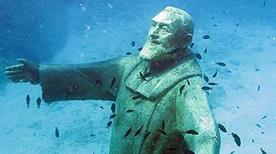
Statua di Padre Pio
Isole Tremiti
Near the Island of Caprara it is possible to take a dive to visit the largest underwater statue, that of Padre Pio. The bronze statue has fallen to about thirteen meters deep to a height of three meters and eighty centimeters. It was placed in 1998 and the work is by the sculptor Matteo Norcia. Another element that makes the island backdrop really fascinating.

Relitti isole Tremiti
Isole Tremiti
The island's seabed is rich in 'treasures' and wrecks of various eras. The oldest one dates back to the first century BC in 1550 is instead a Turkish boat found together with bronze cannons. Among the most important wrecks is a steamer belonging to the fleet of Garibaldi and the Thousand that sank into these waters in 1864. In the early 1980s, instead, a ship was discovered used for trade in the Mediterranean. It carried about 900 amphorae. Today it is located on these precious seabeds.
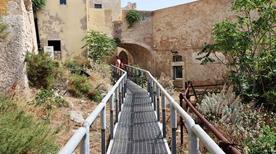
Castello dei Badiali
Isole Tremiti
It's a fortification of the island, built by Charles of Anjou under the order of the Cistercians to repel enemies attacks.
The fort is surrounded by high walls walls. To report a long tunnel that you do not know exactly the outlet, probably another escape route for the friars in case of attack or cache of jewelry and valuables.
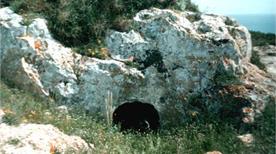
Tomba di Diomede
Isole Tremiti
Tomb of Diomede, based on the myth of the hero of the Iliad, that is considered the founder of the Tremiti Island. (known also for what Diomedee). The story tells that Venus had placed the Diomedee, the companions of Diomedes turned into birds, to protect the tomb.
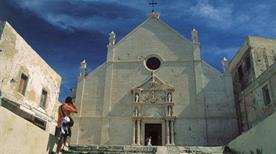
Abbazia di S. Maria a Mare
Isole Tremiti
A masterpiece of the Benedictines first and the Lateran Canons then, built in 1045 at the point marked by a hermit (thanks to the apparition of Our Lady) such as the one in which to find the treasure of Diomedes. Perfected a few years later with Renaissance decorative motifs of Veneto-Tuscany origin, it is composed of three naves and inside are mainly found: the wooden cross representing the Christ suffering is the wooden statue of the Virgin and Child, of Byzantine inspiration; the wooden polyptych of the high altar and the well-known and admired Mosaic Floor.
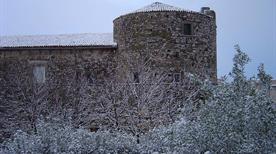
Castello baronale
Apricena
(38 Km)
The Baronial Castle is located in the Municipality of Apricena and was built in 1658. The structure was one of the favorites of Emperor Frederick II both for what concerns the proximity to Foggia and for the rich fauna in the neighboring places. The Castle has its own warehouses, a library and several stables.
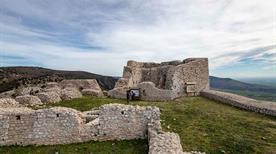
Castel Pagano
Apricena
(41 Km)
The castle is of nineteenth-century origins, even if it has been the subject of continuous restoration in recent years. Since it is a very ancient monument, it has been the scene of several important moments concerning the history of the area. In addition, the castle has passed into the hands of numerous owners. After the '600 it was used as a place of refuge by local shepherds, being in a state of neglect. Today you can see only the ruins, also available to the public.
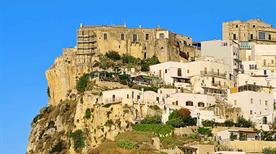
Castello Peschici
Peschici
(46 Km)
The construction dates back to the 11th century and is located on a high rock overlooking the sea. It was built by the Normans with the main purpose of defending against enemy attacks, especially pirates. Monks also resided in the Castle. Since it was very old, it has often been modified and refurbished over the centuries. Today we can admire a massive and impressive construction in excellent condition.
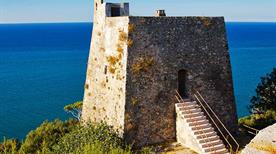
Torre M.te Pucci
Peschici
(46 Km)
The Tower of Monte Pucci is located in the Municipality of Peschici. Since it is located in front of the sea from the tower you can enjoy a beautiful view.
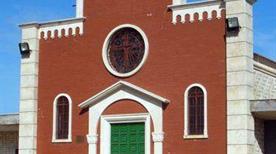
Santuario San Nazario
Sannicandro Garganico
(31 Km)
The Sanctuary was dedicated to San Nazario, who stopped in the spring of thermal water right there where today the sanctuary is located, washing its feet and resting them on a marble stone. Currently, the stone is kept inside the Sanctuary, and is the reason for pilgrimage of many believers.

Il Trappeto Maratea
Vico del Gargano
(45 Km)
Extraordinary site of industrial archaeology, a Gargano oil factory falling under the type “bloody trappets”, operating since the Middle Ages (1300) which tells the scenarios of historic farming Italian and Mediterranean.
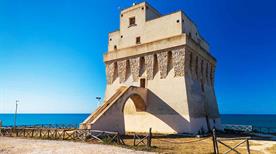
Torre Mileto
Sannicandro Garganico
(30 Km)
The tower of Mileto, in the province of Foggia, is a quadrangular building dating back to the Aragonese period built for defensive purposes. It is believed that the tower is one of the oldest on the coast. The fortification is surrounded by a natural landscape characterized by lush Mediterranean vegetation and a cliff rich in biomarine species, as well as freshwater springs.
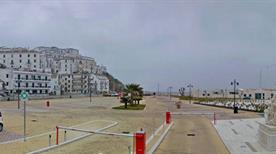
Quartiere “Vuccolo”
Rodi Garganico
(38 Km)
The etymology of the name of the neighborhood comes from the Lombard verb 'vuccular' which means' shouting ', 'calling'. It owes its name to the typical custom of the people to call (vucculare) from the terraces husbands intending to work the nets at “Mer'i varc” ('sea of boats'), the name by which the area is still called today port.
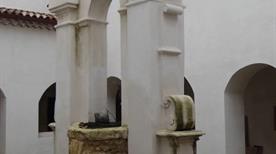
Convento dei Cappuccini
Rodi Garganico
(38 Km)
On a hill immersed in the citrus oasis overlooking the entire beach of Levante, is the first Capuchin convent of the Gargano. Built in 1538 following the typical plan of the Capuchin monasteries, it also includes a church. The complex houses in its underground ancient tombs of ecclesiastics and lay people and has a small cloister of great architectural value. Here are preserved fine paintings and a precious bell melted in Venice in 1782.
Chiesa di San Pietro
Rodi Garganico
(45 Km)
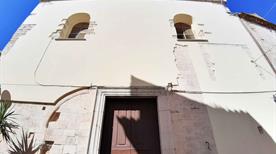
The church of San Pietro, located in a charming square, is the oldest urban church. In ancient times it was part of a convent. Precisely for this reason architecture reflects its functional and historical characteristics. In front of the main entrance, the old cloister of the convent is still visible, incorporated into the houses.

Chiesa di San Nicola di Mira
Rodi Garganico
(38 Km)
Built in 1680, the Church of St. Nicholas was consecrated in 1827 by Archbishop Eustachius Dentice, who deposited above the high altar the relics of Saint Christopher and San Teodoro. Next to the church there is a bell tower more than 20 meters high, of three floors, whose construction took place in two different periods. Until the 17th century the church was used as a lookout tower and was part of the coastal defensive system.

Chiesa della Madonna della Libera
Rodi Garganico
(38 Km)
So called because inside it is preserved the painting of the Madonna della Libera, donated in 1453 by the Venetians who tried to safeguard as many sacred paintings as possible against the invasions of the Saracens. .
Abbazia di Santa Calena
Peschici
(46 Km)
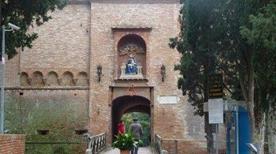
The Abbey of Santa Calena is one of the oldest Italian abbeys. Built in the late 9th century, it became in medieval times one of the richest and most powerful abbeys in the south. The abbey presents architectural elements of Apulian, European and non-European schools. It is thought that this was an important reception center for pilgrims who in ancient times were heading to Monte dell'Angelo.

Castello Svevo
Termoli
(44 Km)
The Swabian Castle of Termoli, is an impressive building and is located near the sea. It was built in the thirteenth century and designed by Frederick II of Swabia; for this reason, the structure is known as the Swabian Castle. The building has been renovated several times, so that it was strategically ready to defend against firearms. In 1885 the castle was named as a national monument and, moreover, classified among the historical museums.

Torre di Petacciato
Petacciato
(97 Km)
The Petacciato Tower was a coastal tower, with a square base structure. Currently, the structure is in a state of total abandonment and only the ruins are visible. In the vicinity of the tower there is a bathing establishment.

Torre del Sinarca
Termoli
(47 Km)
The Tower of the Sinarca was erected in the second half of the 16th century, with the order of Don Pietro di Toledo. Over the years, it underwent several changes in its structure; the last one was in 1963. The latter restoration, commissioned by its current owners, gave it today's appearance. At the moment, inside the tower there is a restaurant open for the public.